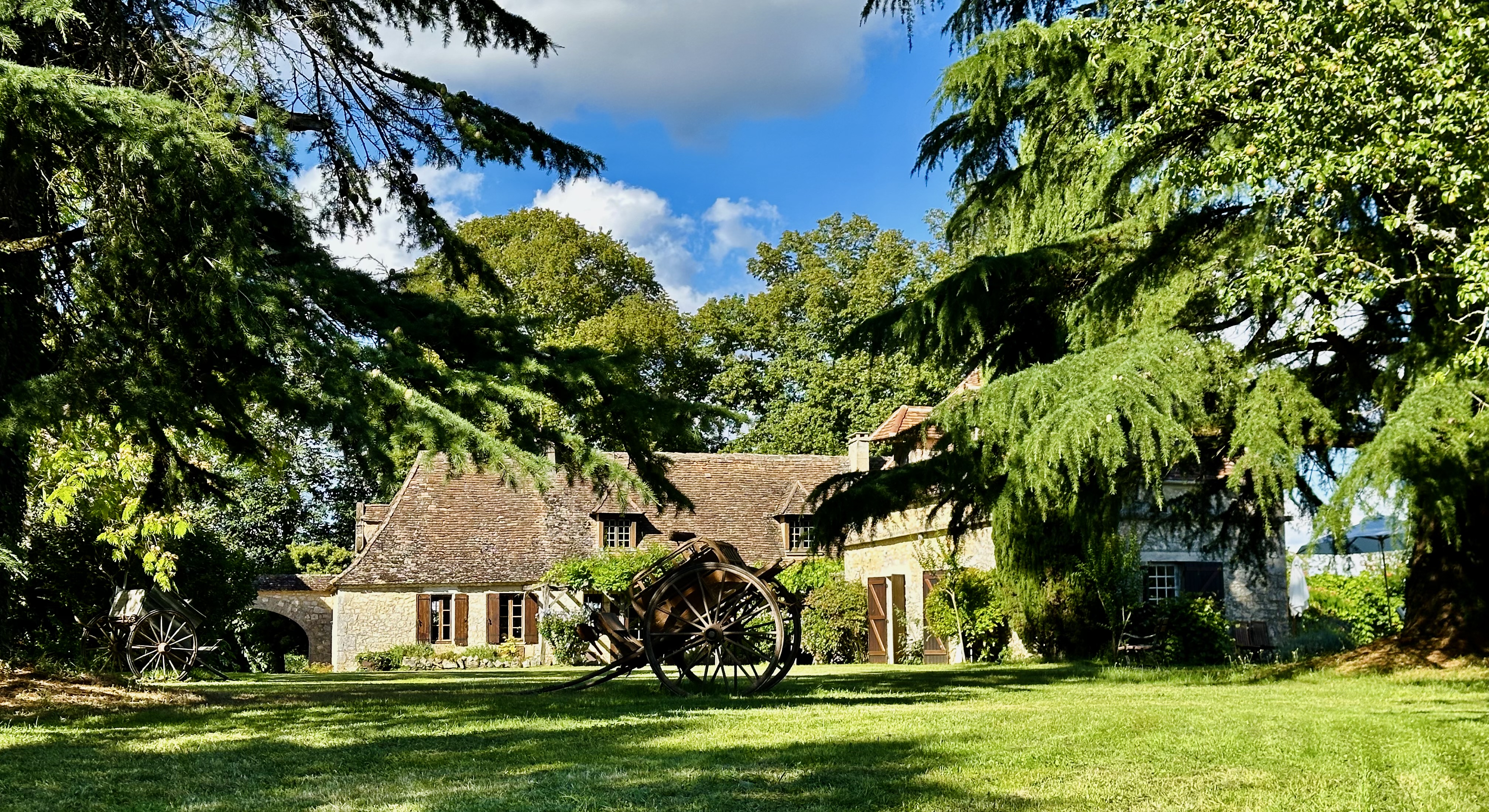
Manoir du Suquet — the courtyard where teams gather, Bardou, Dordogne
Safe2Great Retreats · Run by Skip Bowman

For leadership teams
that want to think properly
and eat well.

Leadership and team retreats on a 19th-century Dordogne estate, run by the author of Safe to Great. Groups of up to seventeen, two to five days, a dedicated training barn, full-estate privacy, and twenty minutes from Bergerac airport.

Most corporate offsites fail for the same two reasons. The venue is wrong — hotels want throughput, conference centres want grey carpet, and neither has ever been the place where anyone had a hard, honest conversation. And the facilitation is wrong — either too light to shift anything, or too heavy-handed to trust.

Safe2Great retreats at Le Suquet are built to solve both problems at once. The estate gives you privacy, slowness, good food, and no distractions. The practice gives you a frame that actually names what teams avoid naming. Three days here tends to do what three months of meeting rooms can't.

Retreat types

Three kinds of retreat we run here.

Most groups fall into one of these shapes. They can be combined, adapted, or run differently. Bespoke design is standard.

01 · Senior team

Executive offsite

For executive teams, partnerships, or founders and their leadership group. Deep work on strategy, role clarity, decision-rights, and the patterns the team keeps repeating. Uses the Safe2Great frame to name what usually gets avoided.

3–5 days · 6–10 people · Full facilitation
02 · Extended leadership

Wider leadership intensive

For extended leadership teams taking on a cultural shift, a transformation, or a hard strategic pivot. Combines plenary work in the barn with small-group sessions across the houses. Built around psychological safety and honest feedback norms.

3 days · 12–17 people · Full facilitation
03 · Thinking retreat

Self-directed, lightly facilitated

For groups who have their own agenda and want space to run it. You get the estate, the kitchens, the grounds, the barn for training, and the occasional intervention from Skip if you want it. Minimal facilitation, maximum quiet.

2–5 days · 6–17 people · Light touch
A typical day

What three days actually look like.

Rough shape of a mid-retreat day. Not prescriptive — every group redesigns the rhythm by day two — but useful for what to expect.

7:00 — 9:00
Breakfast & walking

Self-catering breakfast in your house, or laid out in the courtyard if the group wants to eat together. A loop through the grounds before the day starts — the walnut trees, the fields, sometimes up to the Château de Bardou and back.

9:30 — 12:30
Working session · morning

The hard session of the day. Held in the courtyard if the weather cooperates, or in the barn — the converted grange that serves as the estate's training space — if it doesn't. Mix of plenary, pairs, and small groups depending on what the session needs.

12:30 — 15:00
Lunch & pause

A long French lunch — usually on the pergola at Maison du Seigneur. Deliberately unhurried. Most groups find that the best conversation of the day happens somewhere between the second course and the coffee.

15:00 — 17:00
Working session · afternoon

Lighter than the morning. Often a synthesis session — what do we think now, having sat with it over lunch? This is where shifts happen.

17:00 — 19:30
Free time

The pool, the tennis court, the pétanque piste, a nap, a book, a run through the vineyards. Whatever you need. No evening programme unless the group asks for one.

19:30 onwards
Dinner & whatever happens next

Dinner cooked in one of the kitchens — by a hired chef, a rotating team pair, or whoever wants to cook. Long table in the courtyard when the weather is warm, long table inside when it isn't. Wine from Bergerac. No end time.

The rhythm matters more than the content. Three days of this changes how a team talks to itself. Three days in a conference hotel doesn't.

Why here

What the estate gives
that a hotel can't.

Not a list of amenities. A list of things that change the quality of the work.

Total privacy.

The whole estate is yours. No other guests, no staff walking through, no neighbours listening over a hedge. You can have the conversation that can't happen anywhere else.

Five kitchens.

Self-catering or catered — your choice. Teams that cook together tend to stay together. Teams that want a chef can have one. Teams that want every meal outside can have that. The logistics bend around the work, not the other way round.

Multiple working spaces.

A dedicated training barn for indoor sessions in any weather. A west-facing courtyard that holds thirty when it doesn't rain. Five living rooms for breakout work, a pergola for lunch meetings, and a long table that appears when you need it. No "breakout room 3B" with a projector on a cart.

Proper downtime.

Heated 12×6m pool, tennis court, pétanque, eleven hectares to walk in. The integration of work and rest is the point — not an afterthought. People think better when they've moved.

Location that matters.

Twenty minutes from Bergerac airport, with daily flights from London, Amsterdam, Brussels, Paris and more. Two hours from Bordeaux. Into the Dordogne countryside — Issigeac market, Lascaux caves, Sarlat, the river for canoeing — in under an hour. Getting here is part of the intervention.

Host in residence.

Skip lives and works on the estate. Which means the facilitation is present but not performative — available for the session, unavailable when the team needs its own space. It's a house, not a venue.

Skip Bowman — organisational psychologist, author of Safe to Great, in residence at Manoir du Suquet
Who runs this

Skip Bowman. Organisational psychologist. Author.

Skip is an Australian-born, Sweden-based organisational psychologist with thirty years of consulting experience in leadership, culture, and transformation. He is the author of Safe to Great — the New Psychology of Leadership, and the creator of the Safe2Great framework used by executive teams across Europe and beyond.

He bought the Manoir in 2018 and moved the centre of gravity of his practice here in 2022. The retreats are the part of the work he enjoys most.

Credentials & publications
  • Safe to GreatThe New Psychology of Leadership. First book. The framework.
  • In The DarkHow the energy revolution starts at home. Current investigation, published on vivisolari.com.
  • Thirty years of consulting across Europe, Scandinavia, and the Anglosphere
  • Based in Skåne, Sweden — in residence at Le Suquet during retreats
Safe to Great — The New Psychology of Leadership, by Skip Bowman
The book

Safe to Great.
A copy in every house.

The New Psychology of Leadership. The book that built the framework the retreats are built on. There's a copy in every kitchen at Le Suquet — not because we expect you to read it, but because sometimes a team has a question at ten in the evening and the answer is in chapter four.

Teams that arrive having read it get to the harder conversations faster. Teams that haven't aren't disadvantaged — the retreat is designed to work either way.

Practical

The logistics.

Retreats are bespoke, so pricing and scope depend on the group. But the shape of the thing is consistent, and the practical edges are worth knowing up front.

For anything that doesn't fit the table — longer residencies, hybrid facilitation, combining a retreat with a wedding or family gathering — email directly and we'll work it out.

Enquire about a retreat →
Group size
Up to 17 people — every guest has their own room
Duration
2 to 5 days — 3 days is the sweet spot
Accommodation
17 bedrooms across 5 houses, private terraces
Meeting spaces
The barn · courtyard · pergola · 5 living rooms · long table
Meals
Self-catering, hired chef, or combination
Facilitation
Skip leads. Additional facilitators by agreement.
Travel
Bergerac 20 min — daily flights · Bordeaux 2 hrs
Season
April to October for outdoor work. Barn sessions year-round.
Pricing
On enquiry — depends on scope
Next step

Start with a conversation.

Every retreat is designed from scratch around what the team actually needs. The best way to find out whether Le Suquet is the right fit is a short call, usually 30 minutes, to talk about the group, the situation, and what you're trying to shift.

No booking form. No pipeline. Skip replies to retreat enquiries personally.